
Mielle Pomegranate & Honey shampoo
Moisturizing, detangling shampoo for thick coily hair.
See it on AmazonThe complete family guide
One practical reference for natural curls and coils, occasional heat, chemical choices and locs, from early care to adulthood.

Choose the path you use; you do not need products for every path. Each section separates clinical guidance, educator experience, product directions and practical family suggestions. General education, not an individual care plan or a medical review.
Thairapy is our name for hair time as connection time. It isn’t clinical therapy, and it won’t make every hair day easy. It makes them yours.
Coily hair doesn’t need fixing to deserve care. Your job is patience, preparation, skill, and one promise you keep every time: “When you say pause, I stop.” Their worth isn’t measured by how neat it looks or how long they sit.
Kit out. A calm time, after a snack and a bathroom break. A comfortable seat, plus a story, music or a show they know.
“Twists or two puffs?” “This towel or that one?” Only offer what you can actually do. Choosing a style never means agreeing to pain.
Agree on a word or a raised hand. Stop your hands right away, then ask: pulling, water, noise, or need to move? Fix it, then start again.
Check in after each one. Offer a wiggle break or a hug. Go smaller or simpler when you need to. A timer is for you, not a countdown they have to survive.
“Thanks for telling me what you needed.” “I loved this time with you.” Mirror, high-five or photo if they want. Love never depends on sitting still or looking perfect.
These are practical parenting suggestions, not a tested haircare treatment or a guarantee they’ll cooperate.
Tell them before the rinse and let them help choose when. Control where the water goes; a shampoo visor or a soft-rim rinser cup helps a lot (see the wash station page), but don’t promise every drop stays off.
Hold the section, stop at resistance, and don’t keep redoing a part to make it straight. Pain is information, not bad behavior.
Show them the dryer unplugged first. When you need it, consider kid earmuffs and stop if they’re scared. Don’t crank up a show to drown it out.
A steady, supported seat and a towel help. Don’t force their head into an angle, and never leave them up high or near water alone.
Bring your family’s own music, memories, words and traditions. Learn the story of a style from relatives or a source that actually knows its history. Pride doesn’t need myths about the “oldest hair on Earth.”
When they compare their hair to someone else’s, listen first: “Tell me what you noticed. What feels hard?” Make room for the frustration without calling any texture better. And teach them that nobody touches their hair without asking.
You model commitment in the small stuff: get ready, listen, practice, fix a mistake, come back kindly next time. That’s the lesson. Not that a hairstyle builds character.
A few words is plenty. This is for reflection, not a score for your child.
Morning and night. A weekly check. Monthly, seasonal and yearly look-backs. You’re scheduling attention, not treatments.
These intervals are planning tools. When to wash, trim, relax or retighten depends on the actual hair, scalp and activity, and on what the professional or the label says.
Ask how the scalp feels. Check the roots and ties. Refresh only what needs it, and leave a comfortable style alone. Offer a choice, but don’t make looks a daily performance.
Take out or loosen anything that pulls. Make sure the hair will dry. A smooth bonnet or pillowcase is optional; there’s no required bonnet or nightly oil.
Sources AAD · Hairstyles that pull can lead to hair loss · AAP · How to keep your sleeping baby safe
For dry, coily hair, a full wash every 7–14 days works as long as the scalp is comfortable. Sweaty, itchy or flaky means sooner.
Mist the hair with warm water and a little leave-in milk. Wrap it in a warm towel for a few minutes while they settle in. Just water and warmth, no essential oils.
Recline them in the wash chair or lounger. Wrist-test the water, then wet the hair. Shampoo on the roots, and a soft silicone scalp brush in slow circles with light pressure. Rinse well.
Coat the hair in conditioner. Detangle with a flexible brush from the ends up while it’s in. For a little extra: from about age 3, 5–10 minutes under a hooded dryer on low (under 3, a warm towel over a cap). Rinse.
Earmuffs on, a wide band over the hairline. Part neat box sections, and run a wide-tooth comb through each from the ends to the roots to make sure it’s detangled.
Feed each section in and hold the wand near the roots without pressing on the scalp. From about 3 on the low setting; under 3, cool only. The earmuffs keep the noise from bothering them.
A little gel or edge milk. Smooth twists or braids with a 9-row brush, or sweep the hair into a loose puff with a soft boar brush. Silk scrunchie. Beads only for kids 3 and up who don’t mouth things.
We dropped the lavender or chamomile oil from the warm towel. Lavender oil is in the same NIH report as tea tree, and a plain warm towel does the relaxing just fine.
Sources AAD · How often do children need to wash their hair? · MoKnowsHair · My length retention regimen + tips · NIH · Lavender and tea tree oils may cause breast growth in boys
For daycare dirt, sweat or product buildup between wash days. No shampoo.
Recline, wet the hair, and work in a co-wash (cleansing conditioner). Soft scalp brush, gentle circles, to lift sweat and oil.
Run the detangling brush through while the co-wash is in to catch shed hair and new knots. Rinse well.
While it’s damp, a drop of jojoba or grapeseed oil, then gather a loose puff with a soft brush and a silk scrunchie. Satin bonnet for sleep (toddlers and up, never babies).
Sources AAD · How often do children need to wash their hair?
Moisturizing, detangling shampoo for thick coily hair.
See it on AmazonSoft silicone bristles for slow circles on the scalp. Light pressure only.
See it on AmazonRich, slippery conditioner for detangling.
See it on AmazonThe flexible detangling brush MoKnowsHair uses; bristles bend around knots.
See it on AmazonFor parting clean box sections and a final check.
Search on AmazonSmooths and separates twists and braids.
See it on AmazonSoft bristles to gather hair into a puff without dragging.
See it on AmazonCleansing conditioner for mid-week refreshes.
See it on AmazonFor loose puffs; the right size so it isn’t wrapped tight.
Search on AmazonFor sleep from toddler age. Never for babies under 1.
Search on AmazonOnly for kids who don’t put things in their mouths. Check them daily.
Search on AmazonStore links are for convenience; we haven’t tested every item, and prices change. Check the current listing before you buy.
| When | Look at | Don’t make it automatic |
|---|---|---|
| Weekly check | The next wash or takedown, swim and sports days, a clean kit, the handoff to the other caregiver. | Exactly seven days between washes, or a big new style every Sunday. |
| Wash day, when needed | Choose, cleanse, deep condition and detangle, leave-in, style wet, dry hands-off. | A pre-poo, oil, heat cap, extra mask and blowout every single time. |
| Monthly look-back | Hairline, scalp, repeat tangles, ends, how products are working, one skill to practice. | Harsh detoxes, protein treatments, new purchases, length tracking. |
| Each season | A trim (about every 3–4 months, sooner if ends split), new activities, accessory fit, tools, and whether the routine still works. | A set trim length, a relaxer appointment, replacing everything. |
| Once a year | What they like now, how much they can do themselves, time, budget, and whether you need professional help. | A yearly straightening service or a specialist visit when everything is fine. |
Painful pulling, sores, an itch that won’t quit or noticeable thinning doesn’t wait for the monthly check. Loosen the style now and get anything ongoing looked at.
| Path | The routine changes |
|---|---|
| Loose natural | Regular gentle detangling, comfortable styles and takedowns, a spot refresh when needed. |
| Occasional heat | A check before each press, no-reheat upkeep, and a wash and reset. Not a monthly press subscription. |
| Chemically treated | A service log and a check before any repeat application. The calendar doesn’t clear anyone for a relaxer. |
| Locs | Separate plans for washing, drying, retightening and styling, based on the method and the roots. |
Babies: gentle and minimal. No tension, no small decorations, and safe sleep before any hair goal. Cradle cap or scalp worries that stick around go to the pediatrician.
Toddlers and preschoolers: two real choices, show them the tools, honor the pause signal. Small parts, hot tools and scissors stay with you. They can help without having to sit through it all.
School age and teens: teach one skill at a time, then let them practice while you watch. Puberty can change how oily the scalp gets, so adjust washing. Adult services are never a deadline for kids.
Adults: build the routine around your real hair, schedule and taste. New, lasting shedding or crown changes deserve a checkup, not an automatic “it’s just stress.”
Sources AAP · How to keep your sleeping baby safe · AAD · How often do children need to wash their hair?
Print it, or keep a shared note in an app you already use. This website doesn’t send these entries anywhere.
A long hose, a basin, a cart and something to look at. Here’s how to set up wash day so the water comes to them, not the other way around.
Most wash-day fights are about water on the face, cold, and being stuck in one position. Fix the setup and half the battle is gone. Everything here screws together by hand and comes back off when you move.
Set your water heater to 120°F or lower. Test the water on your wrist before it touches their head; warm, never hot. Never leave a child alone in or near water, even for a second, even in a basin.
Sources CPSC · Tap water scalds
Shower fittings use standard threads, so each piece screws into the next in one line from the wall.
Shut the shower valve. Unscrew the old hose bracket or shower head from the arm by hand or with an adjustable wrench (wrap the jaws in a cloth so you don’t scratch it). Wipe off old tape.
Wrap thread-seal (Teflon) tape 3–4 times clockwise around the arm’s threads, the same direction the next piece screws on.
Screw it onto the arm, hand-tight plus a little. Note the date on it; cartridges wear out.
Screw it onto the filter’s outlet (or straight onto the arm if you skipped the filter).
Hose onto the mount, wand onto the other end. Each hose end has a washer inside; make sure it’s seated.
Turn the water on slowly and check every joint for drips. Tighten a quarter-turn if needed. Then test the temperature on your wrist.
No shower arm handy, or washing in a reclining chair? Feed the water from the bathroom sink instead.
Replaces the sink aerator: the faucet still works, and a side port feeds the hose.
See it on AmazonSame chlorine job as on the shower. Sink threads are usually M22/M24, so you may need an adapter to ½-inch.
See it on AmazonLong enough to reach the chair without stretching across a walkway.
Search on AmazonLets you stop the water at the chair, not at the sink.
Search on AmazonCarries rinse water from the basin to the shower or tub drain.
Search on AmazonStore links are for convenience; we haven’t tested every item, and prices change. Check the current listing before you buy.
A shower filter reduces chlorine. Most use KDF or vitamin C, and the NSF standard for shower filters covers chlorine only. That’s it. Most do not soften water: removing calcium and magnesium takes a water softener, not a cartridge. And claims about removing chloramine are much shakier.
Does hard water hurt coily hair? A little. In studies, hair soaked in hard water came out about 7–8% weaker in two of them and no different in another. Minerals build up on the outside of the strand and make it feel stiff and dull. The fix that actually works is a clarifying or chelating shampoo every few weeks, then a deep conditioner.
So a filter is a nice-to-have, not a must-have. If you get one, pick one with a visible replacement indicator or mark the install date, because a used-up filter does nothing.
Older guides claim shower filters “soften” water or stop breakage. The research doesn’t support that. The chlorine reduction is real.
Sources Curl Centric · Hard water and curly hair (research roundup) · NewBeauty · Do filtered showerheads work? · Cleveland Clinic · How to protect your hair from chlorine
Screws between the shower arm and the hose. KDF media to reduce chlorine.
See it on AmazonTwo-cartridge filter with NSF-certified chlorine reduction, per the maker.
See it on AmazonLets you aim the hose bracket. Make sure the threads are standard ½-inch.
Search on AmazonSwaps a 5 ft hose for 8–10 ft of reach, so the water comes to the basin instead of your child coming to the water.
See it on AmazonPick one with a soft, low-pressure setting and an on/off or pause button.
Search on AmazonThree or four wraps on the threads stop drips.
Search on AmazonStore links are for convenience; we haven’t tested every item, and prices change. Check the current listing before you buy.
Pick one per row. Both tiers do the same job; premium just does it more comfortably.
Lies flat with a built-in pillow; the hose carries water to the drain.
See it on AmazonA firmer bowl on a stand with a soft neck rest.
Search on AmazonAbout 15 inches wide, so it fits a small bathroom. Products on top, tools below.
See it on WalmartHeavy metal frame with five drawers; the top holds a dryer base.
See it on AmazonCatches drips outside the shower and folds flat for storage.
Search on AmazonKeeps the floor dry under the styling chair.
Search on AmazonPuts moving stars on the ceiling, so eyes stay up and water stays off the face.
See it on WalmartA sharper, quieter star field for the same job.
See it on AmazonWaterproof cape to keep clothes dry; cinch it so it isn’t tight on the neck.
See it on AmazonWarm after the rinse; the satin hood is gentle on a damp hairline.
Search on AmazonReclines with a padded neck rest over its own basin; folds flat.
See it on AmazonA sturdier recline for older kids and longer sessions.
Search on AmazonStore links are for convenience; we haven’t tested every item, and prices change. Check the current listing before you buy.
A ceiling star projector gives them something to watch, which keeps their head tipped back and water off their face.
A cape keeps clothes dry. A warm towel or a satin-hooded robe right after the rinse stops the shivers.
The rolling cart holds products in wash order. You never turn your back to grab something.
A pillow under the neck, a towel to hold, and the same pause word as always. Comfort is part of the routine.
Two cheap tools take most of the fear out of rinsing. Use either one, or both together.
Snap it on like a crown, sitting just above the eyebrows. When you rinse, the brim channels water back and out to the sides, away from eyes, nose and ears. Hands-free, so both your hands stay on the hair.
Rest the soft edge flush against their forehead and pour slowly over the crown. The rim sends the water backward instead of down their face. Good on its own, or with the visor.
Recline them, keep the sprayer pointed back toward the crown, and use a gentle stream. Wrist-test the water first, every time.
No visor or cup keeps every drop off every time, so keep a dry washcloth in reach and the pause word in play.
A soft crown that seals above the eyebrows; the brim sends rinse water back and to the sides. Snap sizing grows with them.
See it on AmazonA cup with a soft rim that rests on the forehead, so you pour the water back over the crown.
See it on AmazonStore links are for convenience; we haven’t tested every item, and prices change. Check the current listing before you buy.
MoKnowsHair adds gentle heat while she deep conditions, and a hooded dryer is the kid-friendly way to do it: 5–10 minutes on low, conditioner in, hair covered with a plastic cap. It helps the conditioner soak in, and it’s handy for setting twists.
Same age rule as every heat tool on this site: under 3, use a warm towel over a plastic cap instead. From about 3, low setting only, short sessions, and only if they can sit still and tell you it’s too warm. Check the air on your hand first.
A soft fabric hood on a hose. Gentle, diffused warmth.
See it on WalmartSalon hood on a rolling stand for even warmth over braids and twists.
See it on AmazonStore links are for convenience; we haven’t tested every item, and prices change. Check the current listing before you buy.
Dryers are loud and kids notice. Earmuffs turn the RevAir or hooded dryer into background noise. Fit matters more than the brand: the cushions should surround the whole ear, with hair pulled out from under them, snug but not pressing.
A wide satin-lined or terry band over the hairline and the tops of the ears keeps warm air and splashes off the edges while you work.
Sources BANZ · Kids vs baby earmuffs
NRR 26 per the maker, in both sizes. Pick by age so the cushions surround the ear.
See it on AmazonAdjustable band that grows with them.
See it on AmazonCovers the hairline and the tops of the ears while the dryer runs.
Search on AmazonSoaks up splashes and blocks warm air; machine washable.
Search on AmazonStore links are for convenience; we haven’t tested every item, and prices change. Check the current listing before you buy.
Beads, bobbles, clips and scissors are choking and cut hazards, and the dryer and oils are no toys either. Keep them in a cart with locking doors and lock it whenever you’re not mid-session. Small parts go in a snap-shut box behind those doors, never loose on a counter or dresser. Keep the key on your key ring or somewhere high, never in the lock.
Rolling station with doors that lock, drawers and a dryer holder.
See it on AmazonSnap-shut box for beads, bobbles and clips; lives behind the locked doors.
See it on AmazonStore links are for convenience; we haven’t tested every item, and prices change. Check the current listing before you buy.
If wash day moves out of the bathroom, a self-contained portable shampoo sink is the top-end option. It rolls on locking casters, has its own clean-water and wastewater tanks, and heats its own water. You fill the tank and plug it in; no plumbing.
Its heater can go much hotter than a child’s rinse should be. Set it to warm, check it on your wrist every time, and keep the wastewater tank emptied so it never overflows.
Sources CPSC · Tap water scalds
A rolling cabinet with its own clean-water and wastewater tanks and a built-in heater. Plugs into a wall outlet; no plumbing.
See it on AmazonStore links are for convenience; we haven’t tested every item, and prices change. Check the current listing before you buy.
Wash, detangle, twist, done. This is the routine for 4A, 4B and 4C hair that’s worn natural, and it needs about six things.
Shampoo. A conditioner with real slip, or a deep conditioner. Your fingers, a wide-tooth comb or a flexible detangling brush. A few clips and a soft towel. That’s the kit. Four big twists or two loose puffs is a finished style, not a placeholder until you learn something fancier.
Hair grows from the scalp. Length is kept at the ends. That’s the core idea MoKnowsHair and Miche Beauty both teach, and it’s the one we follow: you don’t chase growth, you stop the breakage.
So the whole routine comes down to a few habits. Clean scalp. Deep conditioning every wash day. Detangling with water and slip, in sections, ends first. Styles that don’t pull. Hands off while it dries. Satin at night. And consistency over a cabinet full of products.
And the part Miche says best: there is nothing wrong with their hair. Your job is to learn it, not fix it.
Sources MoKnowsHair · My length retention regimen + tips · Miche Beauty · How to grow longer hair by retaining length
The first few wash days take the longest. It gets faster.
Kit within reach, child seated and supported, never alone on a counter or near the tub. Offer two choices and agree on a pause word before you touch a strand.
Hair moves easily? Go straight to shampoo. Badly tangled? Wet it, add conditioner and pick out the worst knots first. Only when you need to.
A few loose sections. Massage with your finger pads, don’t pile the hair on top of the head. Rinse until the water runs clear. Used gel all week or been in the pool? Use a gentle clarifying shampoo this time to clear the buildup.
This is the step that keeps the length. Work conditioner through soaking-wet hair and leave it for the time on the label. Detangle while it’s in, with your fingers, a wide-tooth comb or a flexible brush: hold above the knot, short strokes, bottom to top. Hit resistance? More water or slip, or a smaller section. More force is never the answer.
Rinse, squeeze out the drips with a soft towel or T-shirt, and add leave-in. Style while the hair is still wet, section by section. Keep finished sections clipped apart.
Air dry, or a hooded dryer or diffuser on low. Don’t touch it until it’s fully dry; that’s where frizz comes from. Loosen any thick wet bundle so the scalp can dry. Ask how it feels, and celebrate that you did it together.
This sequence is our family’s practical version of gentle-care principles from dermatology and textured-hair educators. It isn’t a clinically tested, timed protocol, so adjust the order to the hair in front of you.
Sources AAD · 6 curly hair care tips · AAD · Teaching your child healthy hair care habits · AAD · Tips for healthy hair · MoKnowsHair · My length retention regimen + tips · Miche Beauty · How to grow longer hair by retaining length · Cleveland Clinic · How to protect your hair from chlorine
The hair goes into the water already detangled and sectioned, and it stays that way. Best for thick 4B/4C hair.
Part dry hair into four big sections. Mist each with water and work in a slippery pre-wash cream or detangler.
Fingers first for shed-hair clumps, then a wide-tooth comb or flexible brush from the ends up to the roots.
One big, loose two-strand twist per quadrant. They get in the bath with four twists.
Undo one, shampoo the scalp and let the suds run down the lengths without piling the hair up. Loosely re-twist. Next one.
Undo one, work in conditioner, run the brush through to check it’s smooth, re-twist. Rinse with the twists still in.
Blot with a microfiber towel so it’s damp, not dripping. Leave-in section by section, then style, or set up for drying.
Sources Miche Beauty · How to grow longer hair by retaining length · MoKnowsHair · My length retention regimen + tips
One continuous-mist bottle does the daily refresh. Mix 60% distilled water, 30% leave-in conditioner and 10% jojoba oil. Shake before every use and mist only the sections that need it, barely damp, never soaked. Mark the fill lines on the bottle with a marker. Empty, rinse and remix every 1–2 weeks instead of topping up an old batch. L·O·C at a glance: Liquid = water + leave-in · Oil = jojoba or JBCO · Cream = curl smoothie or twist butter. The map below helps you pick LOC or LCO.
Decision map
How their hair acts after wash day tells you which order to use: liquid, oil and cream.
After wash day, how does their hair act?A feel test, not a lab result. Skip the glass-of-water float test; it measures surface oil, not porosity.
Split a section in two and wind. Fewer, bigger twists mean a shorter session and an easier takedown.
Three strands, outer over middle. They hold through play longer than twists. Their own hair is plenty; no extensions needed.
Gather with your hands and tie with a covered band or satin scrunchie. Move the spot each time so the edges get a break.
Start with clean, deep-conditioned, soaking-wet hair (keep a spray bottle handy). Rub the gel between your palms, then smooth it through one section at a time and rake or brush to define. Hooded dryer, diffuser on low or air dry, and don’t touch until it’s fully dry. A crunchy cast? Scrunch in a drop of oil once it’s dry. Best for older kids who can sit for it; count drying time and takedown too.
Sources AAD · Hairstyles that pull can lead to hair loss · Miche Beauty · 8 reasons why your wash and go failed · Miche Beauty · How to do a wash and go on Type 4 hair
The everyday workhorse. Bigger sections, fewer twists, shorter session.
About 3–5 min per twist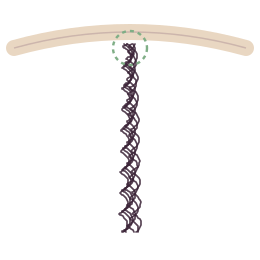
Damp hair, a little leave-in, knots already released. Fewer, bigger sections make for a shorter session.
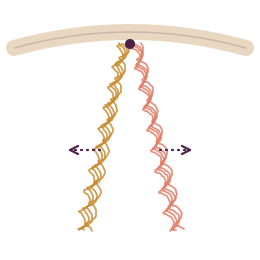
One in each hand. Keep the base relaxed. Nothing should pull at the root.
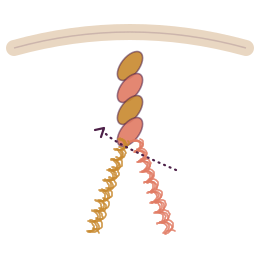
Keep the tension light and even all the way down. If they wince, you’re holding too tight.
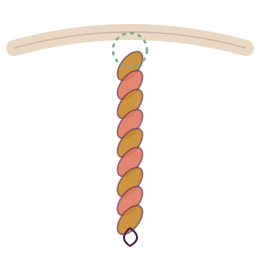
Finish at the tips and coil the end around a finger. Coily hair usually holds without a band.
Holds longer than a twist and unravels less on active days.
About 3–5 min per plait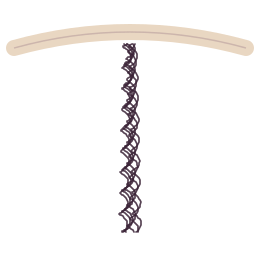
Same prep as a twist: damp, detangled, a little slip.
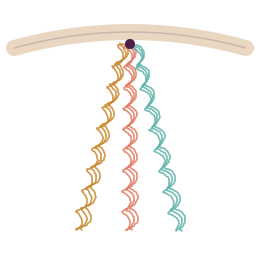
Roughly equal strands. Perfect parts are optional.
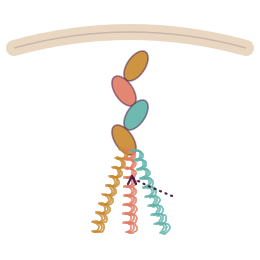
Right over middle, left over middle, repeat. A light, even grip that doesn’t tug the scalp.
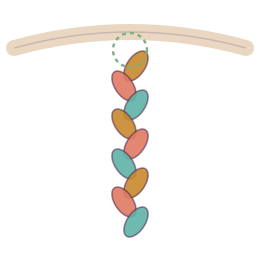
Plait to the ends. No tented skin at the root, no wincing. If it pulls, loosen it now.
The fastest finish there is. The only rule: loose band, moving spot.
About 5 min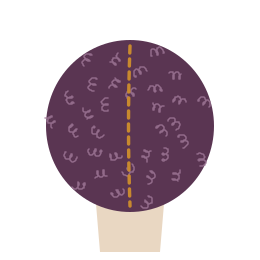
One puff: skip the part. Two puffs: a loose center part with your finger is plenty.
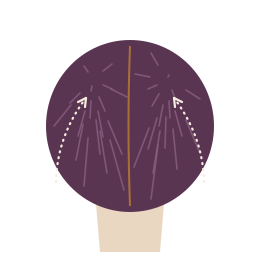
Smooth the hair toward each spot with damp palms and a little leave-in. Brushing the edges tight is how hairlines thin.
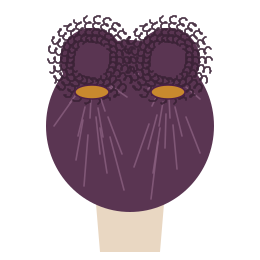
A covered tie or satin scrunchie, wrapped just enough to hold. Two fingers should slide under it.
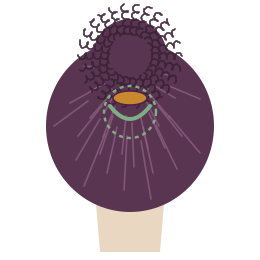
High, low, left, right. Rotating where the puff sits gives the edges a break.
When a front plait or twist keeps swinging into their eyes, change where it starts and where it ends.
Start the plait just behind the temple and angle it back toward the ear, not straight down the face. The direction you braid is the direction it falls.
Slide a smooth side comb in against the direction of the plait, or close a matte claw clip around the plait plus a little of the hair behind it. Open it fully, set it down, let it close.
Bring the end behind the ear and join it to the next section or a low puff with a PuffCuff or satin scrunchie.
Nothing should pull at the hairline or leave a mark. Take clips out before naps and bed.
Under 3, skip the mini claws and side combs (small parts). Anchor the end to a section behind the ear with a satin scrunchie or a large claw clip instead.
Morning: check that nothing pulls, mist the one section that needs it, and go. Flyaways aren’t a failure. Don’t redo a style that still feels good just because it looks a day old.
Night: loosen anything tight and make sure the hair is dry. Older kids can sleep with a loose “pineapple” (hair gathered high and loose) on a satin pillowcase or under a bonnet. It’s optional and shouldn’t turn bedtime into a fight. Babies are different: nothing loose in the crib.
Takedown: start at the ends and unwind. Shed hair collects in a style; that’s normal, so separate it gently. A little slip helps. Never drag a comb through a whole tangled style, and keep scissors away from a wiggling child.
Sources AAD · Hairstyles that pull can lead to hair loss · AAP · How to keep your sleeping baby safe
| Job | Start with | Add only when |
|---|---|---|
| Clean | One suitable shampoo | A gentle clarifying shampoo when gel, product or pool buildup piles up. Clarify occasionally, not every wash. |
| Condition / slip | One deep or rinse-out conditioner with real slip | Deep condition every wash day; that’s the step both MoKnowsHair and Miche Beauty build around. One product, not a stack. |
| Manageability | Nothing extra if hair handles well | A leave-in helps your actual handling or finish. |
| Hold / definition | No styler required for every simple style | Choose one gel, not all three alternatives in the kit. |
| Oil / butter / protein | Not part of the required toddler kit | An identified need and a suitable product. How the hair behaves decides whether oil goes before or after cream. Oil isn’t a growth boost. |
Sources Cleveland Clinic · How to protect your hair from chlorine · MoKnowsHair · My length retention regimen + tips
Porosity matters more than curl type, but skip the glass-of-water float test. A cosmetic chemist has shown it measures the hair’s surface oil, not how much water it takes in, so it can point you the wrong way. Watch how the hair behaves instead. Soaks up water fast, dries fast and frizzes easily: treat it as higher porosity and go LOC (liquid, oil, cream). Water beads up, takes a while to soak in and products sit on top: treat it as low porosity and go LCO (liquid, cream, oil), with lighter products and a warm cap while you deep condition.
Oil doesn’t clean the scalp and doesn’t fix an itch. Protein and bond products are optional extras, not a cure for damage. Many educators, MoKnowsHair included, trim about every three to four months. Trim sooner if the ends split or keep catching.
Wash when the scalp needs it: sweat, dirt, product, an itch. For dry, curly hair, the dermatology chart for ages 8–12 suggests about every 7–10 days, which matches the weekly wash day most educators use. Don’t skip a needed wash to save a style.
Porosity is real, but home tests are rough guides. Start with the routine that matches how the hair behaves, then adjust after a couple of wash days.
Sources Society for Pediatric Dermatology · Curly/coily hair care · AAD · Black hair: tips for everyday care · AAD · 6 curly hair care tips · Lab Muffin Beauty Science (Dr. Michelle Wong) · Hair porosity tests are a lie · MoKnowsHair · My length retention regimen + tips · AAD · How often do children need to wash their hair?
The hairline is part of the scalp, not a styling zone. Here’s how to smooth edges at every age without the tension that thins them.
The hairline is the most fragile hair on the head and the first place tension shows up. If you see thinning, bumps, broken hairs or soreness along the edges, skip styling them, loosen anything pulling, and see the scalp page.
Decision map
Check the hairline first, then pick the routine for their age.
Any thinning, bumps, broken hairs or soreness along the hairline?
How old are they?
Never put fresh gel over yesterday’s dried gel. Wipe the hairline with a warm, damp cloth first. Stacking product makes white flakes and more brushing, and more brushing means more tension.
Coily hair smooths best with water and slip in it. Mist first, then style. Dry edges plus a brush is where snapping happens.
A pea per side is plenty. Heavy product builds up, flakes and gets scrubbed off with more force. Less is gentler.
Sources MoKnowsHair · My length retention regimen + tips · Miche Beauty · 8 reasons why your wash and go failed
Goal: comfort and moisture. Their hairline is still filling in.
A light mist of a water-based leave-in spray along the hairline.
Warm it between your fingertips. A curl cream or kids’ leave-in, no gel.
No brushes, no combs. Smooth gently back the way the hair grows.
A soft satin-lined band while you get them dressed. You should be able to slide a finger under it. Never for sleep, and take it off if they fuss.
Press a warm, damp microfiber cloth along the hairline to lift old product.
A water-based edge gel or light pomade. Patch test anything with essential oils first.
A soft boar-bristle brush, light strokes, back toward the style.
An adjustable satin band, snug not tight, while they get ready.
Water first. Firm gel on dry edges is how hairs snap.
A small amount, worked in with fingertips.
Swoops and waves are fine; scraping the same spot daily isn’t.
Snug enough to set, never tight enough to leave a line or a headache.
Take the scarf off and smooth one or two drops of light oil over the set hair.
| Age | Styler | Tool | Hold | Reset the buildup |
|---|---|---|---|---|
| 1–5 | Water-based cream or leave-in | Bare fingertips | Soft | Full wash day, about weekly |
| 6–12 | Alcohol-free gel or light pomade | Soft boar-bristle brush | Flexible | Damp-cloth wipe every day or two |
| 13+ | Anti-humidity gel + a drop of oil | Fine comb or edge brush | Firm | Wipe daily; clarify every couple of weeks |
Fabric does the holding, so you can skip harsh, alcohol-heavy edge gels on kids.
Use the leave-in already on your palms, or one drop of light oil like jojoba, and smooth the hairline back with fingertips or a soft brush.
Put a satin band or scarf over the hairline, snug but comfortable, for 5–10 minutes while they get dressed.
Take it off. The edges stay soft and smooth, with no crunch to scrub off later.
Head sizes are rough averages; measure around the forehead before you buy.
| Age | Best wrap | Why |
|---|---|---|
| 1–3 (about 18–19.5″ around) | Satin-lined stretch band, no ties | Nothing to knot or pull; slips on and off. |
| 4–8 (about 19.5–21″) | Adjustable hook-and-loop satin band | Snug fit you can fine-tune; holds a high puff or sets edges. |
| 9+ (about 21–22.5″) | Long-tail satin bonnet, scarf or durag | Room for braids and twists; ties let them control the fit. |
A soft brush on one side, a fine-tooth comb on the other, and a tail for parting. One tool for smoothing, detail and clean sections.
Close, soft bristles that glide over tight coils without scratching the skin. The one to use on kids.
Water-based leave-in mist for the hairline.
See it on AmazonA soft cream for smoothing without hard hold.
See it on AmazonA kids’ leave-in cream; a pea-size dab is plenty.
See it on AmazonFlexible edge gel. Contains rosemary and mint oils, so patch test first and skip it on irritated skin.
See it on AmazonFirm, anti-humidity hold for teens and adults.
See it on AmazonSoft brush, fine-tooth comb and a tail for clean parts.
See it on AmazonClose, soft bristles smooth without scratching.
Search on AmazonLong, narrow satin scarf for teens and adults.
See it on AmazonAdjustable, so it can be snug without being tight.
Search on AmazonNo ties, no knots; soft enough for 5–10 minutes while you get them dressed.
Search on AmazonFor teens setting waves or edges.
Search on AmazonStore links are for convenience; we haven’t tested every item, and prices change. Check the current listing before you buy.
Practice, playground, pool. Let them move. Here’s the five-minute reset for afterward.
Soccer and dance can leave the same scalp drenched or dry. Look at what actually happened, light sweat, soaked roots or pool water, and follow that branch below.
Light-sweat, heavy-sweat and water branches are practical decision aids. They aren’t a validated sweat scale.
Decision map
What to do with their hair after practice, the playground or the pool.
What just happened?
Is the scalp dirty, coated or itchy?
A loose braid, plaits, twists or a soft puff. Don’t keep tightening the hairline to make it hold.
A covered band or satin scrunchie that holds without pulling. Take out beads and clips, follow the team rules, and never change how a helmet fits to make room for hair.
No oil or gel coat needed before every game. Older kids can wear a clean sweatband if the sport allows it.
Cool down, take off the damp band, check the scalp. For a child, a simple style after play is plenty.
| What happened | What to do | What not to do |
|---|---|---|
| Light sweat / comfortable scalp | Blot the hairline gently, remove a damp band, and let roots dry. Assess whether any section needs a small refresh. | Automatically shampoo, fully detangle, or add more product after every light session. |
| Heavy sweat / very damp roots | Rinse and condition when that suits dry coily hair; shampoo when dirt, oil, residue, or scalp needs call for cleansing. Rinse thoroughly and plan drying. | Use perfume, oil, or repeated dry shampoo to hide an uncomfortable scalp or postpone needed washing. |
| Swimming / pool or salt water | Rinse with fresh water right away, braids stay in. Squeeze with a microfiber towel, then at home wash with a gentle clarifying or swimmer’s shampoo and deep condition. Dry fully before bed (full steps below). | Use rubbing alcohol on hair or scalp—ever. Sleep on soaking-wet braids. |
| Irritation, sores, or unusual loss | Stop pulling styles or irritating products and obtain appropriate assessment. | Treat persistent symptoms as sweat or dryness by default. |
Sources AAD · How often do children need to wash their hair? · AAD · Teaching your child healthy hair care habits
The dermatology washing chart is written for ages 8–12: dry, curly hair about every 7–10 days, plus a rinse and condition after heavy sweating or swimming. For a toddler, go by how the scalp feels and how dirty it got, and ask your pediatrician if you’re unsure.
AAD’s rinse-and-condition guidance is kept here as advice for that age group. We don’t convert it into a toddler timetable.
Sources AAD · How often do children need to wash their hair?
Choose a style that tolerates movement. After drying, reshape just the sections that need it. A gel refresh is optional, not a second wash day.
A loose wrap helps, but sweat brings texture back. Dry the roots, never flat-iron damp hair, and skip the daily hot touch-ups. A simpler style is fine.
Be extra gentle where new growth meets processed hair. No heavy tension plus repeated heat to keep a gym style sleek.
No tight or heavy bun. Give wet locs time to dry all the way through. In the starter stage, get a wash plan from your loctician rather than skipping washes.
Sources AAD · Hairstyles that pull can lead to hair loss · Sisterlocks · Sisterlocks are resilient
MoKnowsHair’s written regimen is weekly: a scalp clarifier, a deep conditioning treatment she calls “the key element” of keeping her length, detangling while the conditioner is in, then stylers on wet hair and a hooded dryer. For workouts she loops her hair into a loose scrunchie bun with a stretchy satin scarf around the hairline, then dries the roots afterward.
We follow the same logic for kids: clean scalp, deep condition, contain the hair comfortably for sports, and always have a drying plan. We leave out the edge gel, the scarf during kids’ games and blow-drying toddlers.
That’s an adult educator’s routine with her own product line, not a tested child-health plan. We reviewed the written page in full; the linked video wasn’t watched end to end.
Before: fill the hair with clean water and leave-in so it has less room for chlorine. After: rinse, wash, deep condition, dry. Rubbing alcohol is never part of it.
Wet the hair with clean water, then work in leave-in conditioner or a light oil. Dermatologists recommend this: hair already full of clean water absorbs less pool water.
Two puffs, pigtails, a single braid or a low ponytail compress under a cap and bounce back. Wash-and-go and twist-outs get crushed.
A kid-sized satin bonnet goes on first, then a silicone swim cap over it. The satin cuts friction frizz; the silicone keeps most of the pool out. Save the double layer for lessons and parties if it is a struggle.
Shower, hose or a water bottle at the pool. Get the chlorine out before it dries in. With braids, rinse through them with your fingers; don’t take them down wet.
Squeeze (never wring) with a microfiber towel or T-shirt. Then a gentle clarifying or swimmer’s shampoo to lift the chlorine, and a deep conditioner to put the moisture back. That’s the dermatologist-recommended order.
Only if you like it: 1 tablespoon of apple cider vinegar in 1 cup of cool water, poured through after conditioning and rinsed out. Keep it out of their eyes and skip it on irritated skin. Leave tea tree and lavender out of the kids’ routine.
Hooded dryer on cool/low for 30–60 minutes, or a diffuser on cool 8–10 inches away. Hair that stays damp inside braids overnight can smell musty and irritate the scalp, so the answer is drying, not alcohol. Then re-mist and redo the puffs: a pool day is a two-style day.
Sources AAD · Must-try summer hair care · Cleveland Clinic · How to protect your hair from chlorine · Nebraska Medicine · Is apple cider vinegar good for your skin and hair? A dermatologist weighs in · Miche Beauty · How to protect your child’s curls in the summer months · NIH · Lavender and tea tree oils may cause breast growth in boys
Pick one shampoo for what happened and one deep conditioner for their age. That’s the whole reset; you don’t need a different mask for every activity.
A kids’ swim clarifier for after the pool. Sulfate-free, scented, no tea tree or lavender on the label.
See it on AmazonShampoo, conditioner and body wash in one bottle for the pool shower. Still deep condition at home.
Search on AmazonFor gel weeks and dull, coated hair. Sulfate-free, with vinegar. Every few weeks, not every wash.
Search on AmazonShea butter and honey, protein-free. The “lavender” is the scent; no lavender oil is listed.
Search on AmazonHoney and olive oil with real slip for dense, knotty hair. Scented; protein-free.
Search on AmazonStore links are for convenience; we haven’t tested every item, and prices change. Check the current listing before you buy.
Young kids don’t need protein treatments. Stick with a moisturizing deep conditioner unless a stylist or dermatologist points to a specific problem.
Masks with peppermint oil, like Camille Rose Algae Renew, are for older kids. Federal health guidance says peppermint oil shouldn’t go on the faces of infants or young children, and conditioner runs down the face at rinse time.
Clarifying shampoos, swim shampoos included, are for buildup days. Used every wash, they leave coily hair dry.
Sources Fairy Tales · Lifeguard Sun & Swim Clarifying Shampoo (Target listing) · SoCozy · Kids Swim 3-in-1 (H-E-B listing) · Skinsort · 4U by Tia Clarifying Shampoo ingredients · Vitacost · SheaMoisture Baby Nighttime Deep Conditioner ingredients · Skinsort · TGIN Honey Miracle Hair Mask ingredients · Skinsort · Camille Rose Algae Renew ingredients · NCCIH · Peppermint oil: science and safety
Silk presses and blowouts, done occasionally and done carefully. Here’s how to prep, protect, keep it and go back to curls. No promises of zero damage.
Under 3: no heat. Air dry, or a RevAir on its cool setting. From about 3, once the hair has real length and they can sit still and tell you to stop, low-heat drying (RevAir on its low setting) is an option. Flat irons and silk presses stay off the table for young kids. For anyone, wait if the hair is breaking, the scalp is sore, or the chemical history is unclear.
No birthday and no product label makes a temperature universally safe. That’s why this guide never gives one.
MoKnowsHair, who silk presses herself, cut her pressing to about twice a year to protect her curls. Occasional really means occasional.
Sources AAD · Teaching your child healthy hair care habits · AAD · Tips for healthy hair · MoKnowsHair · My length retention regimen + tips · RevAir · FAQs · AAP · Electric hair styling products a common cause of burn injuries in children
Decision map
A decision before a temperature. The answer is often “not yet.”
How old are they?
Any breaking, a sore scalp, or chemical history you’re unsure of?
Can they sit still safely and tell you “stop”?
A dryer removes water. A blowout adds tension to stretch the hair. A silk press adds a flat iron to straighten it. A great dryer doesn’t mean you need an iron.
A regular flat iron only goes on fully dry hair. Wet-to-dry tools are their own category with their own directions, so don’t borrow their claims for a regular iron. Follow the labels on the exact tool and protectant.
Sources AAD · Tips for healthy hair
Relaxers, texturizers, color, bleach, past heat damage, scalp issues, reactions. Then ask straight out: would waiting be the better call?
Wash and deep condition first, without a heavy stack of oils and gels. Put a heat protectant made for the tool on while the hair is still wet, before the blow-dry. Not every leave-in protects against heat.
A comfortable setting, airflow moving, as the manual says. Ceramic tools spread heat more evenly on textured hair. An adult runs the appliance around a child. Cords and tools stay away from water.
Don’t keep going over a section chasing bone-straight. Even the lowest setting carries risk, and a protectant’s “up to” temperature isn’t a target.
A loose wrap or another low-tension setup at night. A satin scrunchie for a loose gather. Let a little texture come back instead of re-pressing the edges every day.
Wash when it needs it. If the curl pattern stays changed or the hair breaks after washing, pause heat and get it assessed.
A deep conditioner or mask can’t guarantee the original curl pattern comes back. Heat damage is why “occasional” matters.
Sources AAD · Black hair: tips for everyday care · AAD · Tips for healthy hair · Society for Pediatric Dermatology · Curly/coily hair care · MoKnowsHair · Tips to avoid heat damage
A loose, secure style that works with the sport. A clean sweatband if it’s comfortable and fits the gear. Don’t wrap it tight to “sweat-proof” the press.
Blot, don’t scrub. Take off damp bands and let the roots dry. A cool, low blow-dry is an option for older kids and adults, not a must for a toddler.
Go to a simple style or wash and reset. Don’t flat-iron damp roots. And never skip a needed wash, or skip the game, to save a press.
Burning, scalp pain, smoke, a singed smell or sudden breakage: stop the service now. A skin burn needs medical advice, not a cosmetic “repair” treatment.
Relaxers, texturizers, perms and smoothing treatments, explained one by one. This is how to have the consultation, not a recipe for doing it at home.
This system doesn’t recommend chemical straightening for toddlers. You won’t find a “safe age” or processing times here.
A professional reduces some avoidable risks. It doesn’t make any chemical service risk-free.
Decision map
Get the name of the service, the history and the stop rule straight before anyone books.
Who is it for?
Do you know the exact service, like relaxer, texturizer, keratin or color?
Any sores, irritation or a recent chemical service on the scalp?
Do you know the exact service, like relaxer, texturizer, keratin or color?
Any sores, irritation or a recent chemical service on the scalp?
| Service | What it does | Don’t be fooled by |
|---|---|---|
| Relaxer | Permanently straightens the hair it touches. There are different chemical systems. | “No-lye.” It’s still a chemical, and it can still burn and break hair. |
| Texturizer | Chemically loosens the curl without fully straightening it. | Calling it a conditioner or a curl cream. It’s permanent. |
| Curl perm / permanent wave | Chemically creates or reshapes curls or waves. | The word “perm.” People use it for relaxers too. Ask what chemical, and what result. |
| Smoothing / keratin service | A product plus heat. Formulas vary a lot. | “Same as a relaxer.” It isn’t. Some of these products release formaldehyde when heated. |
Sources Society for Pediatric Dermatology · Curly/coily hair care · FDA · Hair smoothing products that release formaldehyde when heated
Dates and exact products for relaxers, texturizers, bleach, permanent color, perms and smoothing. Plus scalp conditions, sores, allergies, past burns and any breakage now.
Nothing gets processed over irritated or broken skin. Ask them to look at fragile spots and past processing, not just how straight you want it.
Know the formula and any testing it requires. A skin allergy test and a strand test answer different questions, and neither guarantees no reaction.
A touch-up stays on new growth, not the hair that’s already relaxed. Don’t stack chemical systems because a video said the timing works.
Burning isn’t the product “working.” Stop, rinse as the product directs, and get medical help for any injury.
Sources AAD · Black hair: tips for everyday care · FDA · Hair smoothing products that release formaldehyde when heated
Gentle cleansing and conditioning, careful detangling, low-tension styles. Go easy on extra heat. Add a treatment only for a specific problem. “Protein balance” isn’t a reason to buy four repair products.
Relaxed hair never goes back to natural. You grow out new hair, handle the two textures gently where they meet, and trim on your own timeline. A big chop is an option, not a requirement.
Keep a service log and check the hair before every appointment. A calendar reminder isn’t a reason to relax again.
Sources Society for Pediatric Dermatology · Curly/coily hair care · AAD · Black hair: tips for everyday care
An NIH study of adult women found that frequent use of hair straighteners was linked to higher uterine cancer rates. Linked, not proven. It can’t tell you which product or ingredient, or your own risk, and it says nothing safe about childhood use.
The FDA warns that some heated smoothing products release formaldehyde. A federal ban on formaldehyde in these products has been planned for years and, as of this edition, still isn’t in effect; the FDA’s agenda lists a proposed rule for November 2026. So ask to see the ingredients and safety information, ask about ventilation, and don’t take “formaldehyde-free” or “natural” on faith.
Sources NIH · Hair straightening chemicals associated with higher uterine cancer risk · FDA · Hair smoothing products that release formaldehyde when heated · ChemLinked · US FDA sets November 2026 timeline for formaldehyde ban
Burns, blistering, a chemical in the eye or serious pain: get care right away. Trouble breathing or a severe allergic reaction: call 911. Don’t try to neutralize a skin injury with vinegar, lemon or another product.
Traditional locs, microlocs and Sisterlocks. Pick the method you can keep up comfortably, not just the look you love on day one.
This guide covers maintained traditional locs, microlocs and Sisterlocks. Freeform locs are outside what we cover here, not outside anyone’s right to wear them.
| Type | Ask | Plan for |
|---|---|---|
| Traditional locs | Starting with coils, twists, braids or something else? How will that start change as they lock? | Section size, density, unraveling, washing, drying and how they’ll be maintained. |
| Microlocs | How small are the sections? How long will installs and retightens take? | The budget, the skill needed, fragile areas and whether the ongoing time fits your household. |
| Sisterlocks | Is the consultant trained in that specific system? What are the starter and home-care rules? | Consultation, install, follow-ups and method-specific care. Not every small loc is a Sisterlock. |
Ask your loctician to show you how to wash this install without unraveling it. Don’t leave a dirty, itchy scalp unwashed just to protect a starter pattern.
A suitable cleanser, gentle finger pads, a thorough rinse. Dense sections need patient rinsing, not stronger product.
Squeeze with a clean, low-lint towel. Give the roots and the inside of each loc time to dry, with gentle drying if needed. Never bundle or tightly cover soaking-wet locs.
Follow the method for keeping roots from joining. Don’t rip joined roots apart or improvise tools near the scalp.
Retwisting and interlocking are different techniques, and neither is safe at any tension or any frequency. Let an experienced loctician teach you and handle the tough areas.
Sources Sisterlocks · Sisterlocks are resilient · AAD · Hairstyles that pull can lead to hair loss
Pause retightening and tight styles. A loctician can check technique; thinning, sores or scalp changes that last also need a dermatologist.
Small amounts of products that rinse clean. Skip heavy wax and butter. A harsh “detox” soak doesn’t tell you what the residue is.
Secure them without weight or pulling, rinse after the pool, and leave time to dry. Starter locs vary, so get a plan before regular swimming starts.
Ask about time, cost, shed hair and breakage before combing out, combining, reattaching or cutting. Not every loc has to be cut off, and not every loc can come out intact.
Washing follows the scalp and activity. Maintenance follows the method, new growth and your loctician’s plan. Styling backs off when the roots are sore. They don’t all happen at one appointment or on one monthly date.
A satin or silk cover is an optional extra if it fits safely. Keep it clean and skip tight bands. For kids, comfort, weight, small parts and supervision matter more than polished locs.
Sources Sisterlocks · Sisterlocks are resilient · AAD · Hairstyles that pull can lead to hair loss
Where steam fits, why some educators use it, and when to skip it. Feeling softer is one thing; growth, repair and toddler safety are another.
Leave hot steam out of the toddler routine. A good conditioner and gentle hands are all you need to start.
This review found no proven toddler benefit, no safe toddler protocol, and no reason to add a steamer to a toddler’s kit.
Sources AAD · Teaching your child healthy hair care habits · PATTERN · Hair Steamer FAQ and safety instructions
In a 2016 article, MoKnowsHair describes steaming as a way to add moisture and help conditioner and elasticity, alongside a demo of a Kiss Red Pro steamer.
That’s an educator’s product demo, not a controlled comparison. So we don’t repeat its claims that steam is the most effective method, prevents split ends or improves length retention.
Her current written regimen (2024) doesn’t steam at all. She deep conditions under a processing cap for 5–10 minutes, and adds 10–15 minutes with a heat source for low-porosity hair. That’s the simpler version we’d start with for an adult.
We reviewed the written article. The linked video wasn’t watched in full.
Sources MoKnowsHair · Hair Health with Kiss Red Pro Hair Therapy Steamer · MoKnowsHair · My length retention regimen + tips
Makers say steam softens hair during conditioning or refreshes curls. If the hair feels or handles better, that’s a real, personal, cosmetic result. It isn’t proof of healthier follicles or faster growth.
Research on conditioners doesn’t show that adding steam beats the same conditioner used as labeled. We found no toddler trial, no universal schedule, and no evidence every 4A–4C head needs steam.
Steam doesn’t clean the scalp, and it’s not a fix for dandruff, sores, thinning or an itch. Low porosity can make a warm cap helpful during deep conditioning; it doesn’t mean the hair needs a steamer.
Sources PATTERN · Hair Steamer product directions · Beard et al. · Electron spectroscopy and microscopy applied to chemical and structural analysis of hair · AAD · Tips for healthy hair
These are cautious suggestions, not proof it works equally well or safely for every hair type.
| Hair choice | Possible place in the routine | Important boundary |
|---|---|---|
| Loose natural curls/coils | An optional conditioning step, when the product and appliance instructions permit it. | Not required for a wash-and-go, softness, or healthy growth. Skip it when ordinary conditioning already works. |
| Before a silk press | Only an optional wash-day conditioning step, before the drying and styling stages. | Rinse products as directed, use appropriate heat protection and dry fully before a conventional flat iron. Steam is not a heat protectant. |
| Maintaining a finished silk press | Usually skip deliberate steaming when the goal is to keep the pressed shape. | Steam is used by brands to refresh curls; reversion can oppose the purpose of maintaining a straightened style. Do not repeatedly re-iron to undo it. |
| Relaxed or texturized hair | Discuss any optional conditioning treatment with a stylist who knows the chemical history. | Do not add heat while chemicals are processing unless the exact professional protocol requires it. Steam does not undo a relaxer or make damaged hair safe for another service. |
| Curl perms or heated smoothing services | Use the service-specific aftercare plan, not the relaxer or natural-hair routine by default. | “Perm” is ambiguous. Tell the stylist which chemical/service was used and ask before changing the aftercare. |
| Traditional locs and mature microlocs | An optional cosmetic choice only if it suits the method and drying plan. | Not a substitute for washing or an excuse to add residue-heavy masks. Never comb through formed locs with steamer prongs. |
| Starter locs and Sisterlocks | Ask the experienced loctician or qualified Sisterlocks consultant before adding treatments. | Do not copy loose-natural conditioner/steam routines into a developing loc system. Follow the agreed cleansing, separation and drying plan. |
Sources PATTERN · Hair Steamer product directions · AAD · Tips for healthy hair · Society for Pediatric Dermatology · Curly/coily hair care · Sisterlocks · Sisterlocks are Resilient!
How to decide, not operating instructions for any one steamer.
Name the problem you’re solving. Try better conditioning technique first. Don’t buy a device because a calendar says “monthly treatment.”
Make sure they can be used together, and how. Hooded steamers, handheld vapor tools, warm caps and bonnet dryers aren’t interchangeable.
Follow the conditioner’s directions. Add steam only where both the product and the device say you can. Don’t stretch a mask out to match an influencer’s session.
Follow the steamer’s safety rules. Burning or discomfort means stop now. Never improvise with a kettle, a bowl of boiling water, a garment steamer or a face attachment.
Rinse or leave in the product as labeled, then dry and style. Keep the steam step only if it’s worth the time, cost and hassle.
Sources PATTERN · Hair Steamer product directions · PATTERN · Hair Steamer FAQ and safety instructions · AAD · Tips for healthy hair
Hot vapor and hot parts burn. No steam on an irritated or broken scalp. A burn, blisters, pain that lasts, trouble breathing or a leaking device means stop and get help.
The PATTERN product page and its FAQ list different times, and the FAQ contradicts itself on temperature and scalp use. So we won’t pick a number and call it safe.
Before using that model, get the current manual and ask the maker to clear up the differences. The older Kiss demo doesn’t set the rules for today’s devices. This guide doesn’t approve any steamer for toddlers.
Sources PATTERN · Hair Steamer product directions · PATTERN · Hair Steamer FAQ and safety instructions · MoKnowsHair · Hair Health with Kiss Red Pro Hair Therapy Steamer
A steamer is optional. It doesn’t replace shampoo, conditioner, gentle detangling, or a dryer when drying is what you need.
A warm cap gives warmth. A hooded dryer moves hot air. A steamer gives water vapor. A steam flat iron is a high-heat styling tool. Don’t swap their settings or safety claims.
Keep it simple: try your normal conditioner routine first. If an adult tries steam, note whether it really made the hair easier to handle without discomfort. If not, drop the step.
Sources PATTERN · Hair Steamer product directions · AAD · Tips for healthy hair
Start with what you own. One product per job. If you can’t say what it does, don’t buy it.
“What job does this do, and do I already own something that does it?” One product per job. That’s the whole rule.
“Fragrance-free” is worth checking on the exact variant you buy. It lowers the odds of irritation; it doesn’t guarantee none.
| Priority | Item | Why it’s here |
|---|---|---|
| Core | One shampoo | Cleans the scalp. Pick a formula and follow the label. |
| Core | One deep conditioner with real slip | Detangling and moisture in one step. Deep condition every wash day; no need to stack a second mask. |
| Core | Fingers + a wide-tooth comb or a flexible detangling brush | Fingers for the big knots, then a comb or a flexible brush (the kind MoKnowsHair uses) through conditioner. Pick one tool. |
| Tools | Wide-tooth sectioning clips + a soft towel | Double-hinged alligator or silicone-band clips hold thick sections without snagging. Skip flat snap clips. |
| When needed | A gentle clarifying shampoo | For gel, product or pool buildup. Every few weeks, or after swim days; not every wash. Named picks are on the active-day page. |
| When needed | Covered ties or a satin scrunchie | For puffs and gathered styles. Twists don’t need them. |
| When needed | A leave-in or detangler | If it makes the hair easier to handle. A rinse-out isn’t automatically a leave-in. |
| When needed | One styler | For hold or definition. Not proof you did a good job. |
| Optional | Sleep accessory, dryer, practice mannequin | Only for a real comfort, drying or learning need. |
These are researched manufacturer listings, not products we have tested on our own family. No exact product here is certified by this guide as universally toddler-suitable.
Defining Gel™ · 16 oz
Definition and hold—not a required toddler step.
Directions. Maker: apply to freshly washed, soaking-wet, product-free hair in small sections. Solo use is an option; let hair dry fully before fluffing.
Limits. The maker also allows an optional mousse pairing. That is not a requirement to buy two stylers. No guaranteed flake-free or seven-day result here.
Curl Defining Gel · 8 oz
A curl-definition alternative—not a layer to add after Big Poppa.
Directions. Maker: use on clean, detangled, soaking-wet hair; apply in small sections, distribute, then let the style dry before disturbing it.
Limits. There is no compulsory second cream step in this shortlist. Results and tolerance vary; no toddler-specific performance trial is claimed.
Heavy Hold Flaxseed Gel · 3.4 oz / 100 mL sample
A fragrance-free option to investigate—not an in-stock recommendation.
Directions. Maker: style on soaking-wet hair; its directions describe a moisturizer pairing. Read the current label before deciding whether that extra step fits your kit.
Limits. Do not silently substitute another scent, hold, or size. Fragrance-free does not mean allergy-proof. The older 8 oz/$29 listing was not verified for this release.
Prices and stock were checked October 26, 2026 and change often. Product verification notes.
Check the current bottle and your child’s response. Existing suitable products can fill the same jobs.
Exact fragrance-free shampoo
One possible cleansing product. Keep a suitable existing shampoo instead when it already works.
Directions. Wet hair, apply, lather, and rinse according to the maker. Avoid eyes.
Limits. Do not label it tear-free, “best for ages 2–5,” or a medicated scalp treatment.
Fragrance Free · 12 fl oz
One rinse-out conditioning/slip option—not a required brand switch.
Directions. Maker: apply after shampooing, concentrate on ends, leave 1–2 minutes, then rinse.
Limits. Not a leave-in. Individual slip and tolerance vary; no claim it exactly matches another brand.
Black Satin Sleep Scrunchies · 5-piece
For a loose gathered style when a suitable tie is needed.
Directions. Choose a comfortable fit; do not wrap repeatedly to make the roots tight. Follow the fabric care label.
Limits. Not essential for every hairstyle, not an infant sleep product recommendation, and not “zero damage.”
Prices and stock were checked October 26, 2026 and change often. Product verification notes.
A smooth covered tie holds a loose puff, bun or braid with less snag. Buy a small set in the right size. A soft band doesn’t make a tight ponytail safe; if you have to wrap it four times, it’s too big.
Satin is a weave; silk is a fiber. Either works, so pick one, not both. Check for exposed elastic and rough seams, toss damaged ones, and keep small parts away from little kids.
“Sleep scrunchie” marketing doesn’t make anything safe for a baby’s crib. Nothing loose goes in an infant’s sleep space.
Sources Kitsch · Black Satin Sleep Scrunchies, 5-piece · AAD · Hairstyles that pull can lead to hair loss · AAP · How to keep your sleeping baby safe
Pick accessories that hold by structure, not squeeze. Coily hair is full of volume, so the best clips surround it or lock into it (a PuffCuff, a big claw clip, a side comb) instead of clamping it flat. Look for smooth plastic, a matte finish for grip, blunt teeth, and no bare metal for coils to catch on.
Put them on and take them off the same way: open fully, set it down, let it close. Never slide a clip along the hair. Mist the edges with a little leave-in first so the hairline stays soft. Anything that tents the scalp or leaves a sore spot is too tight.
The age rule: under 3, nothing small enough to choke on. The federal small-parts test is a tube about 1¼ inches wide, roughly a 3-year-old’s throat. If a clip or bow fits inside a toilet-paper roll, treat it as a no for under-3s. (The roll is a bit bigger than the official tester, so it’s a rough check.) Mini claws, bows, side combs and small elastics wait until 3, and come out before naps and bedtime at any age.
Sources CPSC · Small parts for toys and children’s products · CPSC · Small parts: what parents need to know · AAD · Hairstyles that pull can lead to hair loss
| Accessory | Best for | Age | Watch out for |
|---|---|---|---|
| PuffCuff (Junior 3″, Original 5″) | Puffs, half-up styles, gathering big sections | Toddler and up | Match the size to the puff; don’t force a small cuff over a big one. Keep it off the edges. |
| Large matte claw clip | Holding a plait or twist back, quick half-up | Toddler and up (big ones only) | Enclosed spring, smooth seams. Too heavy for a tiny section. |
| Satin scrunchie | Everyday puffs | Toddler and up | Right size, so it isn’t wrapped four times. Not for babies’ sleep. |
| Mini matte claw clips | Pinning a side-swept twist or plait | 3 and up | Small parts. Count them on and off. |
| Smooth plastic side combs | Sweeping a section back from the face | 3 and up | Blunt teeth and smooth seams only. |
| Fully lined bow clips | Decoration | 3 and up | Only “fully lined”: bare metal prongs snag coils. Clip over, never slide. |
| Spiral coil ties | Pigtails and ponytails on twisted or stretched hair | 3 and up | On loose coils they can wind into the hair. Unwind to remove; don’t pull. |
| No-metal elastics (thick) | Braid and twist ends | 3 and up | Not tight. Roll them off instead of yanking. |
| Skip these | Flat snap clips, bare-metal clips, rubber bands, elastics with metal joins, bobby pins on toddlers | — | They snag, pinch, pop open and are small enough to swallow. |
Holds a puff or half-up section by surrounding it, not squeezing it. Kid size.
See it on AmazonThe bigger size for full puffs and thick sections.
See it on AmazonBig enough to hold a whole plait or twist back; can’t be swallowed.
See it on AmazonPins a side-swept twist or plait at the temple. Small parts: 3 and up only.
See it on AmazonNo hinges, nothing to pinch. Check that the teeth are blunt and the seams smooth.
See it on AmazonRibbon wraps every bit of metal, so it can’t snag coils. Buy “fully lined” only.
See it on AmazonSpread pressure over a wide area; best on twisted, braided or stretched sections.
See it on AmazonNo metal joint to cut or snag. For braid ends and big sections.
See it on AmazonStore links are for convenience; we haven’t tested every item, and prices change. Check the current listing before you buy.
For your hands while you work, not for wearing. Snap clips pop open and snag thick hair; these don’t.
Wide teeth and a hinge that opens wide enough for thick sections. The wash-day workhorse.
See it on AmazonThe silicone strip grips without pinching or leaving a dent.
See it on AmazonLong, slim and straight for clean parts on braids and twists. For your work area; don’t leave them in a young child’s hair.
Search on AmazonStore links are for convenience; we haven’t tested every item, and prices change. Check the current listing before you buy.
| Routine | Keep | Conditional additions | Usually skip at the start |
|---|---|---|---|
| Loose natural | Shampoo, rinse-out conditioner, comb, clips, towel | Leave-in, one styler, suitable ties | Multiple gels, oils, masks, edge control, a premium dryer |
| Traditional / small locs | Suitable cleanser, low-lint towel, a realistic drying plan | Method-approved conditioner/styler, comfortable covering, trained maintenance tools | Heavy wax/butter layering, home detox kits, a detangling brush for the loc lengths |
| Occasional heat | Core loose-hair kit | Protectant labeled for the tool, suitable dryer; direct-heat tool only for the chosen service | Two premium dryers, daily reheating tools, extra scalp oils |
| Chemically treated | Suitable shampoo/conditioner, gentle tools | Targeted treatment or protectant for an identified need | A home relaxer kit or automatic monthly protein/bond stack |
| Optional steaming | The usual suitable cleansing and conditioning routine. | An adult may consider a compatible device only after checking the current manual and product directions. | A steamer for a toddler or an already workable conditioner routine. |
Pull the shed hair out of combs and brushes, wash them the way the maker says, and let them dry before you put them away. Wash scrunchies and bonnets when they’re dirty, not just when a reminder pops up.
The spray bottle: mix 60/30/10 (distilled water, leave-in, jojoba), shake before each use, and every 1–2 weeks empty, rinse and remix. Don’t top up an old batch. Cloudy or smells off? Toss it. Homemade gels have no known shelf life, so make small batches. Keep tea tree and lavender out of kids’ mixes.
Dryers and devices follow their own manuals. Don’t boil, soak or spray disinfectant into anything the instructions say not to. Keep every product closed and out of reach.
Dryers, stretching, rinse comfort and ear protection. Start with the job, not the most expensive brand.
| Option | Good for | Keep in mind |
|---|---|---|
| Air-drying in loose sections | Everyday styles, when you have the time | Thick, bundled sections can stay damp. Leave room and time for air to get in. Air drying isn’t damage-free either. |
| The dryer you already own | Drying or diffusing with the right attachment | Keep it moving and about 6 inches away. Distance and motion matter more than the brand. |
| RevAir (RA90020) | Drying and stretching detangled sections, with no heat blowing on the scalp | Heat I ≈ 158°F, II ≈ 220°F, O = cool; tension 1–7. It doesn’t detangle or replace styling skills. |
| Dyson Supersonic Nural (HD16) | Premium drying and diffusing; Wave+Curl diffuser and wide-tooth comb included | Scalp protect mode adjusts heat near the scalp. No proven advantage for kids; you don’t need it on top of a RevAir. |
| Shark Glam (HD6051S) | A dryer plus straightener, glosser, curlers and frizz tool in one | It includes direct-heat tools. Those are for teens and adults, not young kids. |
Sources RevAir · Reverse-air dryer · RevAir · How to use · Dyson · Hair dryers · RevAir · FAQs · Dyson · Supersonic Nural hair dryer · Shark · Glam ceramic air styling & drying system (HD6051S) · Lee et al. · Hair shaft damage from heat and drying time of hair dryer (Ann Dermatol, 2011)
RevAir says it’s safe for all ages because no heat blows on the scalp, face or neck. It gives no child settings, so these are ours: start lower than the adult advice and go up only if you need to.
Use the O (no-heat) setting to dry and stretch, or skip the dryer. Their hair needs length to feed the wand anyway.
Setting I (about 158°F). Save II for older kids and adults. Finish each section with 5–10 seconds on O.
RevAir tells adults to start at 3. For kids, start at 1 or 2 and go up one level only if the hair isn’t stretching. If it tangles or they wince, go down.
Detangled, damp (not dripping) hair with a heat-protectant leave-in. No gel or mousse. Work 2–3 inch squares, smaller for thick hair.
Feed the section in and hold the wand steady near the roots with a gentle dab. Don’t pump it up and down.
Ear muffs if the noise bothers them, breaks when they need them, and an adult runs the machine. “Pause” means pause.
RevAir’s low setting runs around 158°F and high around 220°F, well below flat irons, which can pass 400°F. In emergency-room data, almost all kids’ styling burns came from curling irons and curlers, not dryers. There’s no study of reverse-air drying in toddlers, so we keep the under-3 rule simple: cool setting or no dryer.
A lab study found a dryer used at a distance with constant motion did less damage than air drying alone. The lesson: low heat and motion, not “never heat.”
Sources RevAir · FAQs · RevAir · What levels should I set my speed and heat to? · RevAir · RevAir Kids · AAP · Electric hair styling products a common cause of burn injuries in children
Pulls each section into a wand and dries it stretched. Heat I ≈ 158°F, II ≈ 220°F, O = cool; tension 1–7.
See it on AmazonFive attachments including a Wave+Curl diffuser and wide-tooth comb; Scalp protect mode; 4 heat levels and a cold shot.
See it on AmazonDryer plus Silki ceramic straightener, Glossi ceramic styler, 1.25″ auto-wrap curlers, concentrator and FrizzFighter. Scalp Shield mode.
See it on AmazonStore links are for convenience; we haven’t tested every item, and prices change. Check the current listing before you buy.
Spray milks soak in fast and don’t gum up a RevAir. Use them on damp hair before any heat.
Spray milk; the maker says it protects up to 450°F. Castor oil, black cumin seed, ginger. Lightly scented.
See it on AmazonFragrance-free leave-in labeled as a detangler and heat protectant, made for sensitive skin.
See it on AmazonStore links are for convenience; we haven’t tested every item, and prices change. Check the current listing before you buy.
Compare the current listings. If the dryer inside is the same, extra clips, towels, bags and bottles don’t make it dry any better. Buy the bundle only if the extras fill real gaps at a good total price.
Before you order, check when the return window starts, any return fees and shipping, condition rules, where you’re buying from, the warranty, voltage, and which attachments come in the box. We don’t list prices here because they change.
With a child, introduce the tool first and do a short, comfortable test, only the way the manual allows. Don’t copy an adult’s tension setting. Keep it away from bath water, and stop for heat, pulling or fear.
| Need | Start here | Watch out |
|---|---|---|
| Dryer noise | Cut unneeded noise, and use well-fitting kids’ earmuffs when it helps. | Earmuffs need a good seal and supervision. They aren’t waterproof. Don’t turn a show up to compete. |
| Hating water on the face during rinses | Control where the water goes and how fast. Let them call pause. | A visor or washcloth is optional and won’t keep every drop off. |
| Keeping pool water out | Follow the swim-plug maker’s age, fit and supervision rules exactly. | Small plugs are a choking risk. Don’t push putty into the ear canal, and earmuffs aren’t a swim plan. |
| Ear pain, drainage, tubes, a perforation or ear surgery | Follow your child’s doctor’s water-care advice. | Don’t guess at an ear problem or swap the doctor’s plan for a store-bought fix. |
BANZ makes Baby (newborn–2) and Kids (2–10+) earmuffs, and the maker lists both at NRR 26. The difference is fit, not protection: the cushions should surround the whole ear, with hair pulled out from under them, snug but not pressing. Switch to the Kids size when the Baby band is maxed out or the cups no longer cover the ears.
Sources BANZ · Kids vs baby earmuffs
Follow the model’s filter and cleaning instructions. Check cords, guards, attachments and clips. Damaged or questionable electrical gear isn’t a bargain.
Store tools unplugged, away from kids and water. A soft bonnet-dryer attachment doesn’t mean you can walk away. A scalp massager is optional; you don’t need one to clean the scalp or grow hair.
A small practice studio for sectioning, twists, plaits and gentle takedowns. Learn on a mannequin before your child has to sit through your learning curve.
Pick one hand skill. Stop while it’s still useful. You’re after a relaxed grip and a routine you can repeat, not a perfect part or a style your child has to endure.
Use your fingers to split the hair into easy areas. Clean parts come after the knots are out. Clip finished sections apart.
Split a section in two and cross them around each other. Practice a relaxed base, and undoing the twist without pulling.
Split into three. Outer strand over the middle, then the other side. Practice a light, even grip and letting go from the ends.
Add a little hair with each under-cross. On the mannequin, focus on the hand motion, not tightness. A patient stylist can check your technique on real hair.
Undo the style slowly from the ends, separate shed hair, and use slip when needed. An easy style is easy to take down, not just fast to put in.
Sources AAD · Hairstyles that pull can lead to hair loss · AAD · Teaching your child healthy hair care habits
Decision map
Check this after every install, and again the next morning.
Any wincing, headache, bumps or sore spots at the base?
Is the skin at the roots tented, shiny or pulled up?
Do the same edges or ponytail spot take the tension every week?
Did they ask to stop or say it hurts during the session?
Learn it on a mannequin first. Wide lanes, low hands, no tightness.
Practice skill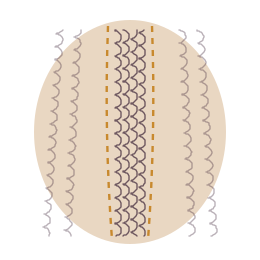
Clip the rest away. Wide lanes are easier and gentler while you’re learning.
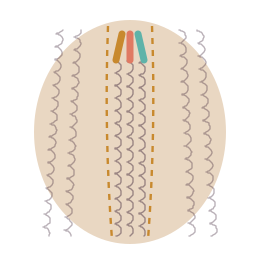
Take a small section at the front of the lane and split it in three.
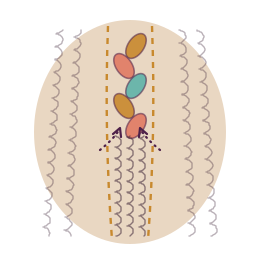
Outer strand under the middle, then pick up a little hair from the lane before the next cross. Keep your hands low on the scalp, not pulling up.
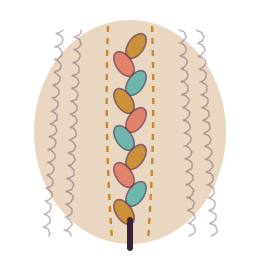
At the end of the lane, keep plaiting to the ends. Tightness is not the goal. Neat comes with practice.
Under 3: no beads, bobbles or small clips in the hair at all. That’s the same line federal law draws for small parts in kids’ products. A soft silicone bead is still a choking hazard.
From 3, only if your child doesn’t put things in their mouth. Secure every bead, check them every day, and take out any that are loose. If there’s a baby or toddler in the house, those beads are their hazard too.
Store beads, bobbles and clips in a snap-shut box behind a locked door, never loose on a counter. Covered ties and satin scrunchies in the right size are the safe everyday choice.
For clips, combs, bows and ties by age, see the accessory guide on the kit page.
Practical teaching tips, not a tested haircare method.
When to simplify, when to take a style down, and when it’s time for a doctor instead of another product.
Trouble breathing, a swelling face, a chemical in the eye or a serious burn: call 911 or go to the ER. Spreading painful redness, fever, pus or a tender, swollen scalp: get seen today. Don’t try a home fix first.
Decision map
Start with what is urgent, then narrow down who can actually help.
Any trouble breathing, facial swelling, a chemical in the eye or a serious burn?
Spreading painful redness, fever, pus, or a tender swollen scalp?
What are you seeing?
| What you see | Do this first | Who can help |
|---|---|---|
| Pulling, pain, bumps or raised skin after styling | Loosen it or take it down today. Don’t wait for it to “settle.” | A skilled stylist can fix the technique. If it lasts, or there’s hair loss, see a clinician. |
| An itch, flakes, sores or scratching at night that won’t quit | Stop the newest product and any experiments. Don’t keep adding oil. | Kids: pediatrician or dermatologist. Adults: dermatologist or primary care. |
| A bald patch, broken hairs or a tender, scaly spot | Don’t guess from a photo, and don’t share combs. Get it checked. | A clinician, who can tell infection, inflammation and tension damage apart. |
| Thinning edges, a widening part or crown changes | Less tension now, and an early appointment. Don’t cover it with a tighter style. | A dermatologist. A loctician or stylist can’t diagnose scalp disease. |
| Tangles and frayed ends, but the scalp is fine | Look at how you detangle, the style and the takedown. | A textured-hair stylist for trims or bad matting. |
Sources AAD · Hairstyles that pull can lead to hair loss · AAD · Black hair: tips for everyday care
You can’t tell dry scalp from dandruff, eczema, infection or a product reaction by the color of the flakes. A bald patch isn’t automatically ringworm. Never give a toddler an adult medicated product because of a photo or an influencer’s routine.
Conditioner can make hair feel and handle better. That doesn’t mean the breakage was “lack of moisture.” Unusual or lasting hair loss needs a checkup, not a protein treatment or a growth oil.
Jot down when it started, any new products or services, tight styles, and whether it hurts. Bring the product labels and photos. That helps the appointment. It isn’t a diagnosis.
A good consultation is about technique, history and boundaries, not just a photo of the finished style.
Bring the names and dates of every chemical, color, bleach, relaxer, texturizer, smoothing treatment and major heat service. Plus past burns, irritation, thinning, scalp diagnoses and product reactions.
For locs, talk through the starter method, section size, how the roots look now, the retightening technique, washing, drying, repairs and removal. Small locs are a different long-term commitment, not just a smaller version of the same appointment.
“Please keep the roots relaxed. Stop right away when we ask. Check with me before you change the style, add a product, use heat or chemicals, or cut more than we agreed.”
Burning or pulling is called normal, or your child is shamed for saying it hurts.
They start a chemical service without asking about past processing, the scalp or the product directions.
Straightening, extensions or a fancier style get pushed as the only way the hair is “acceptable.”
They can’t explain the service, what the products do, the upkeep, or when to see a doctor.
Sources AAD · Hairstyles that pull can lead to hair loss · FDA · Hair smoothing products that release formaldehyde when heated
For the bathroom mirror, the gym bag and both homes. Print this page. The full guide has the details.
Two simple choices. A pause signal, and your hands stop when they use it. Wiggle breaks. End with a hug, even if the style ended up simpler than planned.
Painful pulling: loosen it or take it down. An itch, sores, a bald patch or thinning that sticks around: see the pediatrician. When they say pause, your hands stop.
Checked October 26, 2026. A maker’s directions do not establish comparative benefit or pediatric safety. No product was tested on this family by this editorial review.
Persistent symptoms, chemical compatibility, fragile hair and product reactions need qualified assessment. Exact dryer bundles/returns and water-earplug variants remain purchase-date checks. The historical affiliate shelf and every linked video are not fully audited. Steaming has no verified toddler protocol in this edition, and conflicting manufacturer instructions need clarification. The loc-care sections are not a substitute for method-specific hands-on training.
General Black-hair guidance, not a toddler-specific trial or a universal schedule.
https://www.aad.org/public/everyday-care/hair-scalp-care/hair/care-african-americanSupports adapting cleansing and detangling to the hair. Suggested intervals are general, not individualized pediatric prescriptions.
https://www.aad.org/public/everyday-care/hair-scalp-care/hair/curly-hair-careChild-focused gentle handling and swimming guidance; not a trial of this family routine.
https://www.aad.org/public/everyday-care/hair-scalp-care/hair/hair-care-habitsExplicitly written for ages 8–12. Its heavy-sweat advice must not be presented as a tested toddler schedule.
https://www.aad.org/public/everyday-care/hair-scalp-care/hair/wash-hairTension and early warning signs apply across hairstyles. A professional installation does not remove traction risk.
https://www.aad.org/public/diseases/hair-loss/causes/hairstylesGeneral care principles. Individual scalp conditions can require a different plan.
https://www.aad.org/public/everyday-care/hair-scalp-care/hair/healthy-hair-tipsTwo-page specialty handout, read including both page images. Includes broad care suggestions, not evidence that a precise heat temperature or routine is risk-free.
https://pedsderm.net/site/assets/files/1028/spd_edi_curly-coily-hair_bw_pub.pdfInfant safe sleep takes precedence over hair-preservation accessories. No birthday-based bonnet clearance is inferred.
https://www.healthychildren.org/English/ages-stages/baby/sleep/Pages/a-parents-guide-to-safe-sleep.aspxSome heated smoothing products release formaldehyde. This is not a statement that every relaxer or every smoothing product has the same formula.
https://www.fda.gov/cosmetics/cosmetic-products/hair-smoothing-products-release-formaldehyde-when-heatedObservational adult Sister Study finding; association is not causation and does not identify the risk of a specific product or an individual child.
https://www.nih.gov/news-events/news-releases/hair-straightening-chemicals-associated-higher-uterine-cancer-riskContamination can arise from ingredients, packaging, use, and storage. Adding water can compromise a finished product’s preservation.
https://www.fda.gov/cosmetics/potential-contaminants-cosmetics/microbiological-safety-and-cosmeticsRead in full on October 27, 2026: weekly wash day, scalp clarifier, deep conditioning as “the key element” (extra time with heat for low porosity), detangling with conditioner and a flexible brush, stylers on wet hair, hooded dryer, enclosed pineapple at night, trims about every four months, heat cut to about twice a year. Adult routine with her own product line; not pediatric clinical evidence.
https://moknowshair.com/blogs/news/lengthretentionregimenWritten in the context of delayed appointments. Useful for cleansing, separation, and consultant support; not a universal maintenance calendar.
https://www.sisterlocks.com/blog/sisterlocks-are-resilientExact 8 oz gel. Contains fragrance. Product instructions are not evidence of toddler suitability or guaranteed results.
https://www.michebeauty.com/collections/curly/products/sculpt-curl-defining-gelCurrent 16 oz listing, not the 12 oz size in an older draft. Contains fragrance. Try the solo application route before adding another styler.
https://thedoux.com/products/big-poppa-defining-gelExact 3.4 oz / 100 mL sample listing was sold out when checked. Do not substitute another hold or scent variant without checking its label.
https://curlmix.com/products/heavy-hold-flaxseed-gel-curly-hair-fragrance-free-sample12 fl oz rinse-out conditioner. Maker specifies 1–2 minutes and rinsing. Not a leave-in or a guarantee against irritation.
https://www.earthsciencebeauty.com/products/fragrance-free-conditionerFragrance-free shampoo; avoid eyes. Not labeled here as tear-free, a pediatric treatment, or a universally best clarifier.
https://www.vanicream.com/product/free-and-clear-shampooSatin is not synonymous with silk. Fit, tension, care label, and the wearer’s age and behavior still matter. Not an infant sleep recommendation.
https://www.mykitsch.com/collections/sleep-scrunchies/products/satin-sleep-scrunchie-blackOptional drying/stretching device. Purchase price, bundle contents, and returns must be checked for the exact listing at checkout; no toddler superiority is established.
https://myrevair.com/products/revairDetangle before use and follow the supplied model manual. Adult demonstrations do not establish a child’s heat or tension settings.
https://myrevair.com/pages/how-toSupersonic dryer variants differ. Airwrap and Airstrait serve different styling roles; they are not interchangeable with reverse-air drying.
https://www.dyson.com/hair-care/hair-dryersMaker distinguishes Baby 0–2 and Kids 2+ sizes. Actual fit and supervision matter. Noise earmuffs are not water protection.
https://usa.banzworld.com/Written article reviewed. The linked full video could not be retrieved for independent viewing. Its superiority, split-end and length-retention claims are not accepted as clinical proof; current device directions were not verified.
https://moknowshairblog.com/hairtherapysteamer/Written product directions describe conditioning and curl-refresh uses, including hovering over locs. These are device/brand claims, not pediatric evidence or a recommendation to buy this tool. Follow the exact manual; online timing instructions differ across pages.
https://patternbeauty.com/products/hair-steamerWritten FAQ reviewed. It contains conflicting duration, outlet-temperature and scalp-use statements. The explicit burn warning says not to place vapor outlets on skin/scalp. No numerical temperature, distance or treatment duration is generalized here; obtain the current manual and clarify discrepancies with the manufacturer.
https://patternbeauty.com/pages/the-hair-steamer-faqLaboratory study describes conditioning deposits on treated hair fibers. It is not a steam-versus-no-steam trial, a growth study, or a toddler safety study. Included to distinguish cosmetic surface effects from clinical outcomes.
https://pubmed.ncbi.nlm.nih.gov/15744444/Method-owner advice in the context of interrupted maintenance appointments: cleansing, separation and low-stress styles. It does not establish a steam protocol for starter or mature Sisterlocks; comments are not clinical evidence.
https://www.sisterlocks.com/blog/sisterlocks-are-resilientCosmetic chemist explains that the float and drop tests measure surface condition (surface tension), not how much water hair absorbs; oils can make hair test "low porosity."
https://labmuffin.com/hair-porosity-tests-are-a-lie/Start at about ½ tablespoon ACV per 8 oz water; never use it straight; stop if irritated; skip on skin conditions; patch test first.
https://nebraskamed.com/node/25651Case reports in prepubertal boys linked to topical products with lavender or tea tree oil; growth resolved after stopping. Basis for keeping essential oils out of the kids’ routine.
https://www.nih.gov/news-events/news-releases/lavender-tea-tree-oils-may-cause-breast-growth-boysTopical use can cause redness or irritation; tea tree oil is toxic if swallowed.
https://www.nccih.nih.gov/health/tea-tree-oilDermatologist: saturate hair with clean water first, add leave-in or oil, wear a cap, rinse right away, clarify occasionally (not daily), deep condition weekly.
https://health.clevelandclinic.org/how-to-protect-your-hair-from-chlorineLeave-in or oil before the pool, swim cap, rinse immediately, swimmer’s shampoo, then deep conditioner.
https://www.aad.org/public/everyday-care/hair-scalp-care/hair/summer-hair-careFDA’s regulatory agenda lists a proposed rule to ban formaldehyde and formaldehyde-releasers in heated smoothing/straightening products, planned for November 2026. Not in effect as of this edition.
https://cosmetic.chemlinked.com/news/cosmetic-news/us-fda-sets-november-2026-timeline-for-formaldehyde-ban-and-fragrance-allergen-ruleClarify, deep condition until soft, then gel section by section on soaking-wet hair and rake through; diffuse on low or air dry. Commercial brand content.
https://www.michebeauty.com/blogs/the-miche-manual-blog/wash-and-go-type-4-hairStart clean, drench with water, use a gel with hold, smooth each section, emulsify first, don’t touch while drying, define patiently, and keep realistic expectations for your texture.
https://www.michebeauty.com/blogs/the-miche-manual-blog/8-reasons-why-your-wash-and-go-failed-and-how-to-fix-itRetention is about protecting ends: detangle with water and slip in sections from the ends up, “more force is not a strategy,” style on wet hair, satin at night, refresh only what needs it.
https://www.michebeauty.com/blogs/the-miche-manual-blog/grow-longer-hair-retain-lengthCap or scarf for swimming, gentle non-stripping shampoo, deep conditioning, leave-in, low-tension protective styles.
https://www.michebeauty.com/blogs/the-miche-manual-blog/how-to-protect-your-child-s-curls-in-the-summer-monthsThermal protectant on wet hair before blow-drying and pressing; ceramic tools for textured hair; damage severity decides whether to treat, grow out or cut. Promotes FHI Heat tools; no temperatures given.
https://moknowshair.com/blogs/news/tipstoavoidheatdamageMaker says it is safe for kids because no heat blows on the scalp, face or neck. Heat I ≈ 158°F, II ≈ 220°F, O = no-heat cool shot. Tension 1–7; start at 3 and II for adults; lower tension if it tangles. No minimum age or child settings given.
https://myrevair.com/pages/faqsTest a wet 3×3-inch section at speed 3 for 10 seconds; go up one level at a time only if needed; cool (O) for the last 5–10 seconds. Not all coily hair needs high tension.
https://support.myrevair.com/hc/en-us/articles/360002730193-What-levels-should-I-set-my-Reverse-Air-Speed-and-Heat-to-Same device marketed for kids; no child-specific settings or minimum age.
https://myrevair.com/pages/kidsLab study on hair tresses: surface damage rose with temperature; a dryer used at 15 cm with continuous motion caused less damage than air drying. Not a study of children.
https://pubmed.ncbi.nlm.nih.gov/22148012/ER data 2013–2022: about 68% of styling-tool burns were in children 10 and under (median age 4.3); curling irons and curlers caused 97.4%.
https://www.aap.org/en/news-room/news-releases/conference-news-releases/electric-hair-styling-products-common-cause-of-burn-injuries-in-children/Set water heaters to 120°F; at 140°F third-degree burns can happen in about six seconds; test water before bathing young children.
https://www.cpsc.gov/s3fs-public/5098-Tap-Water-Scalds.pdfSummarizes studies: one found no strength difference, two found hard-water-soaked hair about 7–8% weaker; minerals collect in the cuticle. Chelating/clarifying shampoo helps; shower filters are not reliable softeners (NSF/ANSI 177 covers chlorine only).
https://www.curlcentric.com/hard-water/Cosmetic chemist: most showerhead filters are not water softeners; KDF reduces chlorine and some metals; vitamin C neutralizes chlorine; chloramine claims are less established.
https://www.newbeauty.com/view/do-filtered-showerheads-work-hair-skinFive attachments (Wave+Curl diffuser, Gentle air, Wide tooth comb, Styling concentrator, Flyaway); Scalp protect mode; 3 speeds, 4 heat levels, cold shot.
https://www.dyson.com/hair-care/hair-dryers/supersonic-nural/amber-silkIn the box: Coanda Auto-Wrap curlers (1.25″), Silki ceramic straightener, Styling concentrator, FrizzFighter, Glossi ceramic styler; Scalp Shield.
https://www.sharkninja.com/shark-glam-ceramic-powerful-air-styling-drying-system/HD6051S.htmlMaker: heat protection up to 450°F; castor oil, black cumin seed oil, ginger; spray on damp hair, don’t rinse. Contains fragrance.
https://carolsdaughter.com/products/goddess-strength-divine-strength-leave-in-milkBaby earmuffs newborn–2 years and Kids earmuffs 2–10+ years, both NRR 26 dB per the maker. Cushions must surround the ear, hair out from under them, snug not tight.
https://usa.banzworld.com/pages/kids-vs-baby-earmuffs-explore-banz-hearing-protectionFederal small-parts rule: products for children under 3 may not contain parts small enough to be a choking hazard. Basis for keeping beads and bobbles away from under-3s.
https://www.cpsc.gov/Business--Manufacturing/Business-Education/Business-Guidance/Small-Parts-for-Toys-and-Childrens-ProductsThe federal small-parts tester is 1.25 in wide and 2.25 in long, about the size of a 3-year-old’s throat. A toilet-paper roll is larger than the tester, so it is a rough home check only.
https://webarchive.library.unt.edu/web/20120915085434/http://www.cpsc.gov/onsafety/2011/12/small-parts-what-parents-need-to-knowPlastic clamp that holds a puff by surrounding it; sizes include Mini (2.5″), Junior (3″) and Original (5″).
https://thepuffcuff.com/products/junior-3-inch-2-pack“Peppermint oil should not be applied to the faces of infants or young children” because inhaled menthol can cause serious side effects. Basis for keeping peppermint-oil masks for older kids.
https://content.govdelivery.com/accounts/USNIHNCCIH/bulletins/37e0f98Sulfate-free kids’ swim clarifier made to lift chlorine, salt and minerals, per the maker. Contains fragrance and grapefruit peel oil; no tea tree, lavender or rosemary listed.
https://www.target.com/p/fairy-tales-lifeguard-sun-swim-clarifying-shampoo-12-fl-oz/-/A-15425265Kids’ swim shampoo, conditioner and body wash with charcoal; sulfate-free per the maker. Contains fragrance and small amounts of hydrolyzed vegetable and rice protein.
https://www.heb.com/product-detail/socozy-kids-swim-3-in-1-shampoo-conditioner-wash-10-5-oz/6514551Sulfate-free taurate/isethionate cleansers, vinegar (acetum), neem extracts, fragrance. No tea tree, lavender, peppermint or rosemary listed. Adult brand made for 3A–4C hair.
https://skinsort.com/products/4u-by-tia/clarifying-shampooShea butter, honey, almond and olive oils, conditioning agents, fragrance. No lavender oil, other essential oils or hydrolyzed protein listed; the “lavender” is the scent.
https://www.vitacost.com/products/sheamoisture-baby-nighttime-deep-conditioner-manuka-honey-lavender-12-fl-oz-340-ml-125915Honey, olive and jojoba oils, aloe, conditioning agents, fragrance, MI/MCI preservative. No essential oils or hydrolyzed protein listed.
https://skinsort.com/products/tgin/honey-miracle-hair-maskButters, plant oils, algae, biotin and peppermint oil (Mentha piperita). Not hydrolyzed protein.
https://skinsort.com/products/camille-rose/algae-renew-deep-conditioning-maskStandard history of Black hair in America. Source for pre-colonial meaning, the Middle Passage and life under slavery. A synthesis, so the teacher reviewer should check specific claims against it.
https://openlibrary.org/search?q=Hair+Story+Untangling+the+Roots+of+Black+Hair+in+AmericaScholarly study of paper-bag and comb tests as rumor and informal gatekeeping. How formal or widespread they were is uncertain.
https://openlibrary.org/search?q=The+Paper+Bag+Principle+KerrSmithsonian museum story on Walker, her work as a Poro agent, her company and her agent network.
https://nmaahc.si.edu/explore/stories/madam-cj-walkers-wonderful-hair-growerMuseum story: the movement “affirmed natural hairstyles like the ‘Afro’.”
https://nmaahc.si.edu/explore/stories/black-beautiful-emergence-black-culture-and-identity-60s-and-70sMuseum explainer on Governor Miró’s 1786 edict and how women of color turned the required head covering into fashion.
https://www.searchablemuseum.com/tignon-laws/History of the hot comb, Malone and Walker, and beauty culture as Black women’s work.
https://spectrum.ieee.org/how-the-electric-hot-comb-became-an-entrepreneurial-toolLists Walker, but says her wealth is “hard to ascertain with certainty,” that she denied being a millionaire, and that other businesswomen may have been earlier.
https://www.guinnessworldrecords.com/world-records/first-self-made-millionairessNotes “some debate” over the first-millionaire title and over how much Walker borrowed from Annie Turnbo (Malone).
https://www.pbs.org/wgbh/roadshow/articles/madam-cj-walker-hair-care-millionaireFinds no tangible evidence for the U.S. version. The Colombian version rests on Afro-Colombian oral tradition.
https://www.snopes.com/news/2022/03/12/maps-cornrows-black-slaves-escape/Geographer’s study of Maroon oral traditions that a woman brought rice hidden in her hair.
https://geog.ucla.edu/sites/default/files/users/carney/302.pdfDocuments African rice still grown by Maroons, which makes the rice-in-hair tradition plausible. It is not proof of the literal story.
https://link.springer.com/article/10.1007/s10745-024-00528-yOverview of the maroon town founded after Benkos Biohó’s escape around 1599 (UNESCO-listed culture). A starting point, not a primary source.
https://en.wikipedia.org/wiki/San_Basilio_de_PalenqueMuseum object showing the “Nubian wig” court fashion.
https://www.metmuseum.org/art/collection/search/329868Describes “three rows of seven conical buns, with larger hemispherical caps over the ears.”
https://kimbellart.org/collection/ap-199603Ivory pendant of Queen Mother Idia of Benin with the restricted coral-bead coiffure.
https://www.metmuseum.org/art/collection/search/318622Over 15,000 drawings and engravings dated from about 6000 BC to the first centuries CE.
https://whc.unesco.org/en/list/179/Federal court upheld an airline’s ban on all-braided hairstyles for an employee.
https://www.courtlistener.com/?q=%22Rogers+v.+American+Airlines%22Appeals court held that pulling a job offer over locs did not violate Title VII as the case was pleaded.
https://www.courtlistener.com/?q=%22Catastrophe+Management+Solutions%22The first state CROWN Act.
https://en.wikipedia.org/wiki/CROWN_Act_(California)State-by-state table: 30 states plus D.C., with limited versions in Arizona and Kentucky (executive orders) and Missouri (schools only). Other trackers count fewer.
https://www.epi.org/blog/thirty-states-have-passed-a-version-of-the-crown-act-to-ban-hair-discrimination-continued-action-needed-more-than-ever-as-trump-administration-abandons-equity/Passed the U.S. House; never passed the Senate.
https://en.wikipedia.org/wiki/CROWN_Act_of_2022Reintroduced and referred to the Senate Judiciary Committee; no vote.
https://www.congress.gov/bill/119th-congress/senate-bill/751December 2018 match; the New Jersey Division on Civil Rights barred the referee for two seasons, ordered bias training and issued hairstyle guidance.
https://www.si.com/more-sports/2019/09/18/referee-banned-force-wrestler-cut-dreadlocksTexas’s CROWN Act did not cover hair length, the judge ruled.
https://www.cbsnews.com/texas/news/texas-school-did-not-violate-crown-act-when-suspending-darryl-george-over-locs-hairstyle-judge-rules/Remaining federal case dismissed July 24, 2025.
https://abc13.com/post/federal-judge-dismisses-darryl-georges-lawsuit-barbers-hill-isd-ending-year-crown-act-battle/17586771/Multiple braids, ponytails and no minimum hair length, with dermatologist input on hair loss.
https://www.army.mil/article/242536/army_announces_new_grooming_appearance_standardsAir Force and Space Force grooming changes.
https://www.military.com/daily-news/2021/01/21/air-force-allow-female-airmen-wear-longer-braids-ponytails.htmlDermatology review of grooming policy changes by branch, including locs across all services by 2018.
https://www.mdedge.com/dermatology/article/242758/hair-nails/buns-braids-and-ponytails-entering-new-era-female-militaryMemo signed August 20, 2025: waivers need a treatment plan; troops still needing one after a year are separated. Most waivers are for razor bumps (pseudofolliculitis barbae), which disproportionately affect Black men.
https://www.military.com/daily-news/2025/09/16/pentagon-says-troops-can-only-be-exempt-shaving-their-facial-hair-year.htmlCourt of Appeal ruling in the case of the child known as ZV.
https://jamaica-gleaner.com/article/news/20240715/appeal-court-rules-kensington-primary-ban-dreadlocks-breaches-constitutionalThe 2020 ruling that the Court of Appeal later reversed in substance.
https://www.cnn.com/2020/08/04/world/jamaica-dreadlocks-ban-student-trnd/index.htmlAllows locs, twists, plaits, Afros and cornrows in schools.
https://storage.moe.gov.tt/wpdevelopment/2023/07/Media-Release-Introduction-of-the-National-School-Hair-Code.pdfNational grooming policy allowing locs and cornrows uncovered in schools.
https://barbadostoday.bb/2023/01/13/bteditorial-finally-the-hair-victory-many-advocated-for/Voluntary pledge for schools and employers, launched by the Halo Collective.
https://www.voice-online.co.uk/news/uk-news/2020/12/14/halo-code-uks-first-black-hair-code-aims-to-protect-employees-from-discrimination/Includes Ruby Williams’s £8,500 settlement (2020), backed by the Equality and Human Rights Commission.
https://cfey.org/2021/11/hair-is-not-just-hair-what-can-be-done-about-hair-discrimination/Equality watchdog guidance: blanket hairstyle bans without racial exceptions are likely unlawful.
https://www.aol.com/pupils-not-unfairly-singled-school-230100414.htmlSister Study cohort; associational, not proof of cause.
https://pmc.ncbi.nlm.nih.gov/articles/PMC9949582/33,497 women followed almost 11 years; 1.64% (never users) vs 4.05% (more than 4 uses a year) estimated risk by age 70. “Uterine cancer is a relatively rare type of cancer.”
https://www.nih.gov/news-events/news-releases/hair-straightening-chemicals-associated-higher-uterine-cancer-riskSister Study association with breast cancer.
https://www.niehs.nih.gov/newsreleases/permanent-hair-dye-and-straighteners-may-increase-breast-cancer-riskPuts the Sister Study finding in context.
https://www.cancer.org/cancer/latest-news/study-finds-possible-link-between-hair-straightening-chemicals-and-uterine-cancer.htmlThe proposal, first targeted for 2024, was still unpublished.
https://www.cnn.com/2026/01/05/health/hair-straightening-formaldehyde-fda-deadlineUnified Agenda: a proposed rule banning formaldehyde and formaldehyde releasers in heated smoothing and straightening products, planned for November 2026. Not published as of November 4, 2026.
https://cosmetic.chemlinked.com/news/cosmetic-news/us-fda-sets-november-2026-timeline-for-formaldehyde-ban-and-fragrance-allergen-ruleCause “not yet fully understood”; PADI3 gene changes may lead to it; hairstyles may play a role but this “has yet to be proven”; most relaxer users never develop it.
https://www.aad.org/public/diseases/hair-loss/types/ccca/causesReview of traction alopecia across styles and ages; early cases are reversible.
https://pmc.ncbi.nlm.nih.gov/articles/PMC8530059/1,042 South African schoolchildren: traction alopecia in 17.1% of girls, rising with age. Often misquoted as U.S. data.
https://pubmed.ncbi.nlm.nih.gov/?term=Khumalo+traction+alopecia+schoolchildren+2007Dove-commissioned surveys of workplace and school hair discrimination, including the 2021 girls study (1,000 girls aged 5–18). Advocacy research, not clinical evidence.
https://www.thecrownact.com/research-studiesNational survey data on daily care by resident and nonresident fathers. Hair care is not measured separately.
https://cdc.gov/nchs/data/nhsr/nhsr071.pdfMatthew A. Cherry’s short about a father learning his daughter’s hair; Oscar for Best Animated Short, 2020.
https://en.wikipedia.org/wiki/Hair_LoveChris Rock’s documentary on relaxers, weaves and the Black hair economy.
https://en.wikipedia.org/wiki/Good_HairHer response after online criticism of her hair at the London Olympics.
https://thegrio.com/2012/08/06/gabby-douglas-responds-to-hair-comments-i-just-made-history-and-people-are-focused-on-my-hair/Context for Malcolm X’s 1962 Los Angeles speech, which includes “Who taught you to hate the texture of your hair?”
https://mic.com/articles/141642/here-s-the-malcolm-x-speech-about-black-women-beyonce-sampled-in-lemonadeHot-comb burns, teasing over twists, hair straightened only for picture day, and representation. Personal account; her use of “complex trauma” is her own framing.
https://www.youtube.com/watch?v=PNpl7KZdlrQTeen insecurity, hair as a quick fix, and Black athletes’ hair under scrutiny.
https://www.youtube.com/watch?v=7l75Hkg7UN4The natural hair movement, the Type 4 representation gap and ownership in the industry. States cornrow maps as fact; this guide treats them as oral tradition.
https://www.youtube.com/watch?v=79Dv2wL7ANkHer mother on hot combs, relaxers, a 1970s Afro, hostility she faced for it, and a big chop in a hard season.
https://www.youtube.com/watch?v=WUNwWsGswE4Her “love story” framing: “Please don’t ever look down on your crown.”
https://www.youtube.com/watch?v=WHP-7SQ8PyASays the cascade coiffure took “some fifty hours” to create; headrests kept it intact.
https://www.metmuseum.org/art/collection/search/314378Fijian buiniga history; calls the Angela Davis link “rumoured.”
https://blog.tepapa.govt.nz/2013/12/06/all-power-to-the-fro/Himba hair and otjize by life stage.
https://fashionandrace.org/database/otjize/Eunoto, where moran braids are shaved, is on UNESCO’s Urgent Safeguarding List.
https://ich.unesco.org/es/USL/enkipaata-eunoto-y-olngesherr-tres-ritos-de-iniciacion-masculinos-de-la-comunidad-masai-01390Official tourism portal on nagô braids and Ilê Aiyê.
https://www.salvadordabahia.com/en/curuzu-trancistas/Return of Emperor Tewodros II’s locks in 2019.
https://theconversation.com/why-its-significant-that-the-uk-has-returned-the-locks-of-hair-of-an-ethiopian-king-113382Tight braids, ponytails and buns can cause traction alopecia at the edges; looser styles help.
https://www.healthychildren.org/English/health-issues/conditions/skin/Pages/Hair-Loss-Alopecia.aspxAsk about hair
Answers come from this guide. General education, not medical advice.